What Karim & Claude built in a July 2026 sprint. Every item below is live — click anything.
One lecture thesis, built as runnable exhibits: competence condenses out of randomness through different engines — selection, reinforcement, gradient descent, self-play. You already got the first two as zips; here they live online, joined by their five siblings.
Dawkins' 1986 weasel program with an editable target sentence: blind mutation plus selection assembles "I THINK THEREFORE I AM" in ~30 generations and three seconds. The Monkeys-mode toggle runs the same target with no selection and shows the arithmetic (27²² strings ≈ 10¹⁷ years at a million tries per second) — the whole difference between random search and evolution in one checkbox.
Run the Weasel →Donald Michie's 1961 matchbox machine, digitized faithfully: 304-odd canonical tic-tac-toe positions, beads as probabilities, win +3 / draw +1 / loss −1, nothing else. Watch the opening matchbox develop convictions live, switch it mid-run from a random opponent to a perfect one (wins collapse, draws surge — Michie's exact historical result), or play it yourself: it learns from you too. Confession included in an earlier note: the first build accidentally cheated via an inverted symmetry mapping and still showed beautiful learning curves. Never trust a curve you haven't audited.
Train MENACE →A 10.7M-parameter character-level GPT (the Karpathy recipe, one Python file) trained from scratch on 220,310 words of Karim's collected writing — 67 minutes on the M4's GPU, loss 4.9 → 1.0. The gallery shows the same network sampled at 13 checkpoints: symbol soup → spaces → proto-words → "**3.1 Reframing the problem**", citing No Logo and mentioning Chris by name. It learned the style, the vocabulary, the document structure, the thematic obsessions — and at no point an argument. Style without thought, watchably.
See language emerge (nano-Karim) →Identical architecture, identical recipe, different soul: Karpathy's tiny-shakespeare (202,651 words). At iteration 20 it was already inventing speaker labels — because its world is a play. Side by side with nano-Karim it makes the cleanest possible point: same 10.7M parameters, two different voices, the data is the destiny.
See language emerge (nano-Shakespeare) →Four trucks, thirty customers, one depot. A 5k-parameter policy net builds routes customer-by-customer, trained by REINFORCE on random maps and evaluated on one fixed map it never sees in training — it learns the skill, not the answer. Overnight result: 4.8% shorter routes than the nearest-neighbour + 2-opt classical benchmark on the held-out map. The gallery shows the same map going from spaghetti to petals.
Watch the routes untangle →An accountant's judgment, learned from rules: a €600k Dutch BV (quarterly btw-aangifte, 2% betalingskorting on ~40% of supplier invoices, a 12%/yr credit line), and a 3k-parameter net deciding weekly which invoices to pay now versus hold. It beat all three benchmark bookkeepers — the Prompt Payer, the Stretcher, and the Discount Hunter — by about €500/year after 470,000 simulated business years. That €500 is the market price of learned judgment over the best fixed rule. Design lesson learned the hard way: when every invoice carried a discount, two of the three benchmark strategies were mathematically identical — the economics had to be realistic before the lesson could exist.
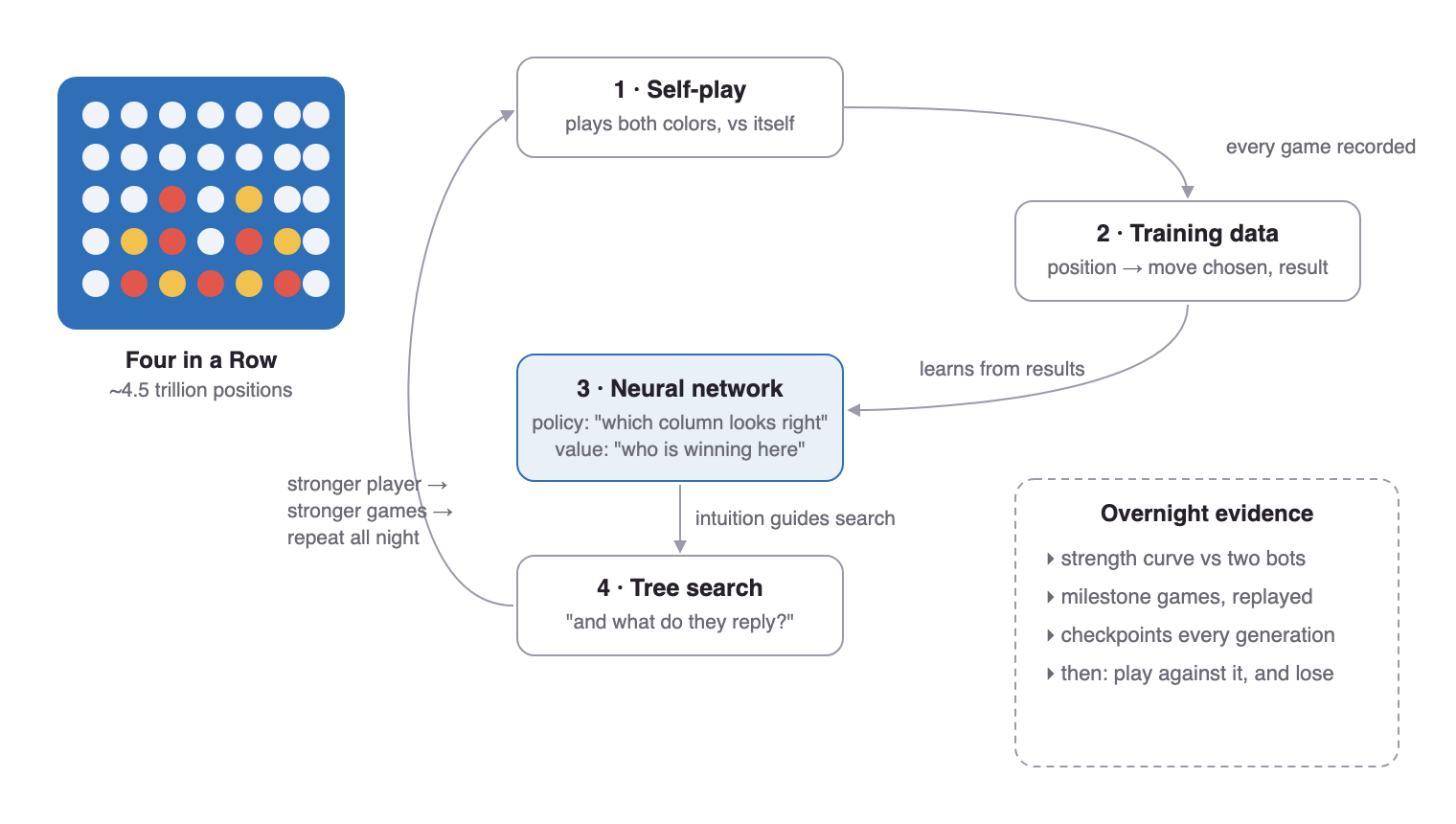
Open the books →The full DeepMind recipe in miniature: a 0.1M-parameter policy+value convnet, PUCT tree search (64 simulations/move), self-play generating its own training data. It went from knowing only the rules to never losing against its sparring partners within minutes; it retired undefeated at generation 7,038. Still owed: a stronger benchmark opponent and the board where Karim formally loses to it. The training loop, as one slide:
 Strength record →
Standing offer from Karim's last note remains open: if a certain competitive engineer raced to his own Connect-Four self-play agent, everyone would benefit from the arms race.
Karim's inequality argument as an executable theorem. Two hundred citizens, equal at the start; every transaction a fair coin flip over 20% of the poorer party's wealth (the yard-sale model — Boghosian et al.: below a critical redistribution threshold, oligarchy is mathematically inevitable). Dials for wealth tax, inheritance tax, capital advantage, basic income, and a Leviticus-style Jubilee; presets from "Rhineland 1970" to "Pure free market". Verified: the free market reaches literal monopoly at year ~518 (Gini 0.99); Rhineland dials stay stable for 1,600+ years at Gini ~0.47. Same coin, opposite destinies. Historical footnote that upgrades any lecture: Monopoly began as Lizzie Magie's 1904 Landlord's Game, designed by a Georgist with TWO rule sets — monopolist and prosperity. Parker Brothers deleted the redistribution rules in 1935. English/Nederlands toggle top-right.
Run the Monopoly Machine →Karim's 2005 book, complete and verbatim in the model's cached context (~34k words per edition), as a conversation with the author: map the territory, get quizzed, ask for the most counterintuitive claim — every quote rendered verbatim with section attribution. Built as exact mirrors; asked the same "surprise me" in their own languages, both independently chose the same burden-of-proof reversal and quoted it correctly. Lush green, because abundance.
Abundance (EN) → Overvloed (NL) →All 19 episodes of the Cornucopia podcast (75k words of spoken transcript) translated to natural spoken Dutch by five parallel agents working under a shared terminology contract — with the two editions of the 2005 book as their parallel-text dictionary. Best translator's find: the ab unda pun actually improves in Dutch ("over-vloed" — you hear the overflow). The result: a Dutch reader can interrogate a podcast that only exists in English.
Cornucopia Interactief (NL) → Cornucopia Interactive (EN, earlier build) →